
 RSS Feed
  Wednesday, July 8, 2026 : 13:14 (+4GMT) Wednesday, July 8, 2026 : 13:14 (+4GMT) | |||
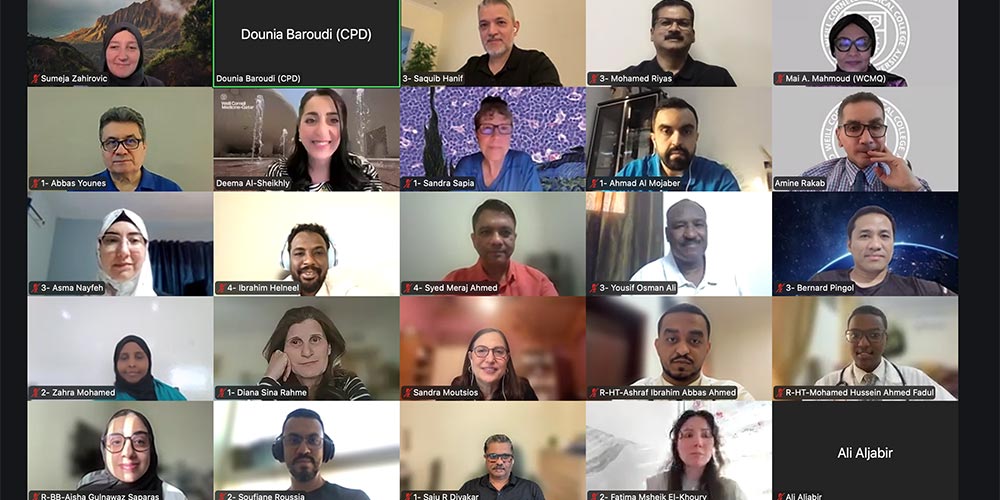
Doha - July 8, 2026: The Division of Continuing Professional Development (CPD) at Weill Cornell Medicine-Qatar (WCM-Q) recently held a faculty development workshop on assessment in competency-based medical education (CBME). The two-day virtual course was designed to provide participants with a better understanding of the implications of competency-based medical education, equip them with the tools needed for effective assessment and feedback, and enable them to apply these techniques to improve direct observation. Internal medicine residents from Hamad Medical Corporation (HMC) also volunteered their time to participate as actors in a role-play exercise on giving effective feedback. Titled 'Assessment in Competency-Based Medical Education: A Faculty Development Program,' the workshop was directed by Ms. Deema Al-Sheikhly, lecturer of education in medicine and director of medical education and continuing professional development at WCM-Q, who also served as a course facilitator and speaker. Other speakers and facilitators from WCM-Q included Dr. Mai Mahmoud, associate professor of teaching in medicine and assistant dean for faculty affairs; Dr. Amine Rakab, assistant professor of clinical medicine and assistant dean for clinical learning; and Dr. Sumeja Zahirovic, assistant professor of medicine Competency-based assessment is at the core of modern graduate medical education programs and was developed in the U.S. about two decades ago. Residents are required to achieve a series of outcomes-based milestones by demonstrating high performance in six core competency areas, namely patient care, medical knowledge, professionalism, interpersonal and communication skills, practice-based learning and improvement, and systems-based practice. The ability to accurately assess achievement of these competencies, as outlined by the Accreditation Council for Graduate Medical Education (ACGME), is therefore a core skill for medical education professionals. The workshop was aimed at residency and fellowship program directors, associate program directors and faculty members with primary responsibility for assessing residents and fellows. Participants included professionals from Qatar-based institutions such as Aspetar, HMC, the Primary Health Care Corporation (PHCC) and Sidra Medicine, as well as attendees from the United Arab Emirates, Lebanon, Palestine and Sudan. The course is based on the ACGME's Faculty Development Hub program. It was accredited in Qatar by the Department of Healthcare Professions-Accreditation Section (DHP-AS) of the Ministry of Public Health (MoPH) and internationally by the Accreditation Council for Continuing Medical Education (ACCME). | |||
|
| |||
| |||
| |||
| ||||||||||||||||||||||||||||||||
| ||||||||||||||||||||||||||||||||
| ||||||||||||||||||||||||||||||||