
 RSS Feed
  Tuesday, March 17, 2026 : 15:30 (+4GMT) Tuesday, March 17, 2026 : 15:30 (+4GMT) | |||
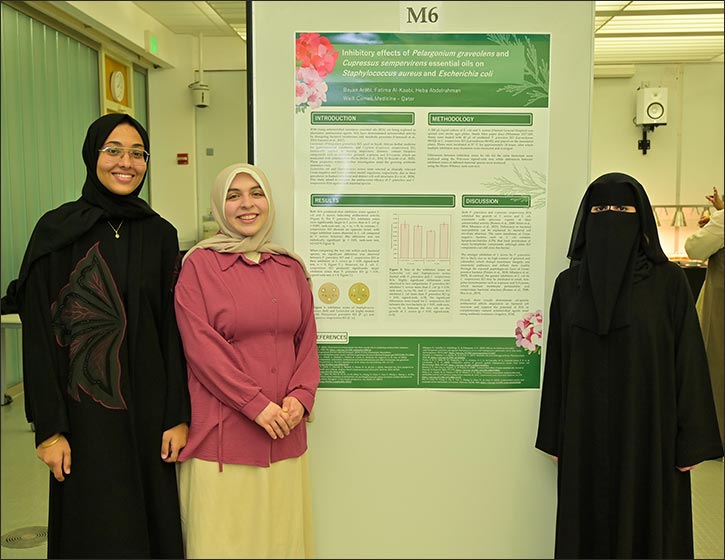
Doha - March 17, 2026: Fifty-six first-year pre-medical students at Weill Cornell Medicine-Qatar (WCM-Q) in February presented posters from their biology laboratory research. Their findings focused on the antimicrobial effects of natural substances obtained from plants, particularly specific plant parts. The students, divided into groups of two and three, presented 20 posters, providing them with an opportunity to demonstrate their ability to conduct and communicate science. They worked together to execute their research projects from beginning to end, including reviewing the literature, formulating a question and a hypothesis, conducting laboratory experiments, and analyzing the data. The students then wrote a short synopsis of their findings and presented their work in poster format to fellow students and faculty members. The annual event, which marks the culmination of two semesters of research, allowed students to search the literature for a topic, after which they were provided with different bacterial species to test in the laboratory. The students then analyzed the inhibitory effects of the phytochemicals for each plant species they used.
Students Jassim Al Hail, Taleb Dahman, and Junseo Yoon presented a poster on the antibacterial effects of barberries (Berberis vulgaris) on Staphylococcus aureus and wild-type and ampicillin-resistant strains of Escherichia coli. Al Hail said: 'We decided to explore the antimicrobial effects of barberry fruit since there has been a global rise in antimicrobial resistance, and we wanted to investigate natural alternatives. The plant has a long history of medicinal value, though many studies have focused on roots and leaves, and we decided to use the fruit. We used two bacterial species and three strains to investigate the antimicrobial activity of an ethanolic paste prepared from the fruit against Staphylococcus aureus and both wild-type and ampicillin-resistant strains of Escherichia coli using agar well diffusion.' Another poster, titled 'Inhibitory effects of Pelargonium graveolens and Cupressus sempervirens essential oils on Staphylococcus aureus and Escherichia coli,' was presented by Bayan Arabi, Fatima Al-Kaabi, and Heba Abdelrahman. The group used geranium (Pelargonium graveolens) and cypress (Cupressus sempervirens) essential oils, both of which have historically been used to treat gastrointestinal conditions and respiratory illnesses, respectively. Al-Kaabi said: 'We tested an essential oil from cypress and geranium flowers, and we used them on the two types of bacteria, which differ in their membranes. We found that Staphylococcus aureus showed greater inhibition probably because it is Gram-positive, whereas Escherichia coli cell membranes are probably harder to penetrate. Our results demonstrated the potential of essential oils as complementary natural antimicrobial agents amid rising antibiotic resistance.' Another group, composed of Sofia Raza, Haya Al-Bustami, and Aldana Al-Dosari, presented a poster titled 'Antibacterial Activity of Cinnamon (Cinnamomum sp.) Extracts on Escherichia coli and Staphylococcus aureus,' where they investigated the antimicrobial properties of Cinnamomum sp. extract on the two bacterial species, as well as the relationship between extract concentration and antibacterial activity. They found that increasing the concentration of cinnamon extract may increase inhibition in both bacterial species. Ayham Alsughair, Ayaan Khan, and Abdullah Qureshi presented a poster comparing the antimicrobial effects of thyme, oregano, may chang, and citronella essential oils on Staphylococcus aureus and Escherichia coli, and found that all four inhibited the growth of both bacterial species. Other student research projects investigated the antimicrobial effects of manuka honey, raspberry, blackberry, garlic, coriander, eucalyptus, rose of Jericho, tulsi, pomegranates, and white Thai guava, among others. These projects were conducted for educational purposes only, and the findings should not be considered clinical trials or medical guidance on the effectiveness of various remedies | |||
|
| |||
| |||
| |||
| |||
| ||||||||||||||||||||||||||||||||
| ||||||||||||||||||||||||||||||||
| ||||||||||||||||||||||||||||||||