
 RSS Feed
  Saturday, May 23, 2026 : 00:00 (+4GMT) Saturday, May 23, 2026 : 00:00 (+4GMT) | |||
 The first two editions are crafted in 18k white gold and feature bezels set with either blue or purple sapphires. The third edition is crafted in 18k red gold and features a bezel set with red rubies. Each bezel is traced by an elegant line of 48 baguette-cut gemstones, all set by hand by the skilled team at the brand’s long-term Friend STG Creation in Geneva - a perfect frame for the complex perpetual calendar calibre, achieved without increasing the diameter of the case. The new pieces are also distinguished by PVD-treated hands matched to their gemstones or case colour; purple for the purple sapphires, blue for the blue sapphires and 5N PVD for the red ruby edition, echoing the tone of the red gold case. Bringing together the horological complexity and craftsmanship of the innovative perpetual calendar mechanism created by Stephen McDonnell with the bold sophistication of colourful gemstones, these new editions are limited to just 8 pieces each - making them among the rarest LM Perpetuals ever crafted. The LM Perpetual Over ten years ago, MB&F and independent Irish watchmaker Stephen McDonnell began with a blank sheet of paper and completely reinvented that most traditional of horological complications; the perpetual calendar. This resulted in the creation of the Legacy Machine Perpetual, featuring a visually stunning in-house movement - developed from the ground up to eliminate the drawbacks of conventional perpetual calendars. The fact that the complication looked sensational and could be fully appreciated dial-side was just one of the many benefits offered by the new movement, controlled by a mechanical processor. The LM Perpetual features a fully integrated 581-component calibre − no module, no base movement − with a revolutionary new system for calculating the number of days in each month. And it holistically reinterprets the aesthetics of the perpetual calendar by placing the full complication on dial-free display underneath a spectacular suspended balance. The perpetual calendar is one of the great traditional complications, calculating the apparently random complexity of the varying numbers of days in each month − including the 29 days in February during leap years. But traditional perpetual calendars do have a few drawbacks: dates can skip; they are relatively easy to damage if adjusted while the date is changing; and the complications are usually compromises of modules powered by base movements. The fully integrated, purpose-built movement of Legacy Machine Perpetual has been designed from scratch for trouble-free use: no more skipping dates or jamming gears, and the adjuster pushers automatically deactivate when the calendar changes, so no problems there either! Traditional perpetual calendar mechanisms use a 31-day month as the default and basically 'delete' superfluous dates for the months with fewer days - by fast-forwarding through the redundant dates during changeover. A traditional perpetual calendar changing from February 28 to March 1 scrolls quickly through the 29th, 30th and 31st to arrive at the 1st. LM Perpetual turns the traditional perpetual calendar system on its head by using a “mechanical processor” instead of the conventional space-consuming grand levier (big lever) system architecture. The mechanical processor utilises a default 28-day month and adds extra days as required. This means that each month always has the exact number of days required; there is no fast-forwarding or skipping redundant days. And while the leap year can only be set on traditional perpetual calendars by scrolling through up to 47 months, LM Perpetual has a dedicated quickset pusher to adjust the year. With its open dial revealing the full complication and suspended balance, it's the harmonious mechanical beauty of LM Perpetual that really steals the show. And in an interesting technical twist, that eye-catching balance hovering on high is connected to the escapement on the back of the movement by what is likely to be the world's longest balance staff. Using an innovative system developed especially for Legacy Machine Perpetual, the subdials appear to 'float' above the movement with no visible attachments. The skeletonised subdials rest on hidden studs, which is technically impossible with traditional perpetual calendar mechanisms because they would block the movement of the grand levier. Taking a clockwise tour of the dial, at 12 o'clock we see the hours and minutes nestled between the elegant arches of the balance; day of the week at 3 o'clock, power reserve indicator at 4 o'clock, month at 6 o'clock, retrograde leap year indicator at 7 o'clock, and date at 9 o'clock. The Legacy Machine Perpetual won the Best Calendar Watch Prize at the GPHG (Grand Prix d’Horlogerie de Genève) in 2016. 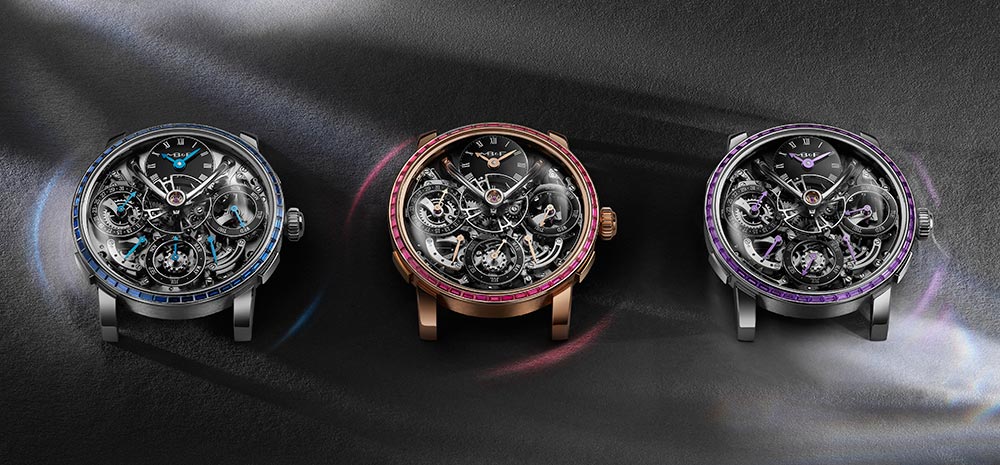 | |||
|
| |||
| |||
| |||
| |||
| ||||||||||||||||||||||||||||||||
| ||||||||||||||||||||||||||||||||
| ||||||||||||||||||||||||||||||||