
 RSS Feed
  Monday, April 27, 2026 : 13:55 (+4GMT) Monday, April 27, 2026 : 13:55 (+4GMT) | |||
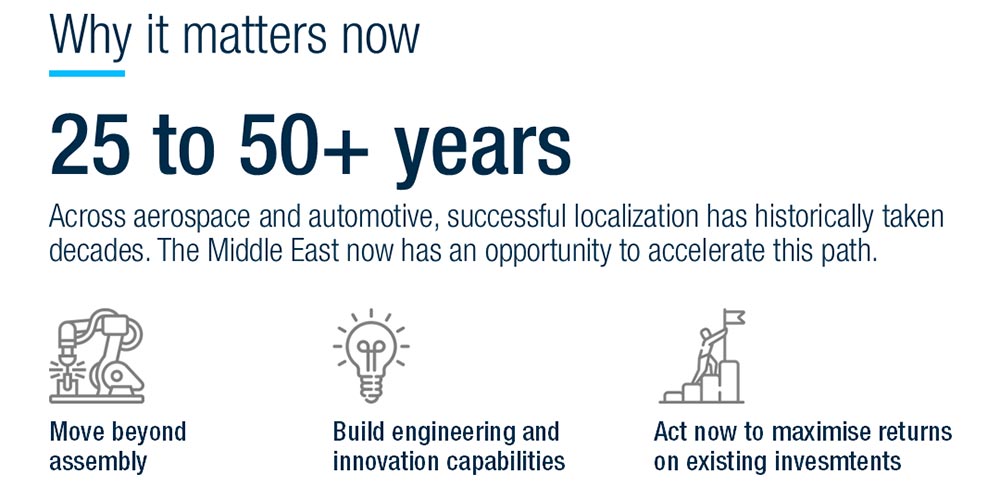
27 April, 2026 - Alvarez & Marsal (A&M), the leading global professional services firm, has DZ1 published a strategic roadmap designed to accelerate industrial localization across the GCC. Detailed in a new whitepaper, Industrial Manufacturing Localization: A Strategic Imperative - Middle East, the study outlines how Gulf countries can shorten traditional industrial development cycles from decades to years through disciplined policy frameworks, deep technology transfer, and ecosystem orchestration. Set against a backdrop of evolving geopolitical dynamics, shifting trade flows, oil price volatility and rising competition for industrial investment, the whitepaper highlights a significant opportunity for Middle East economies to drive coordinated, strategic action. Drawing on global localization case studies across aerospace and automotive manufacturing, the research examines industrial development journeys in Italy, Turkey, Brazil, China, and Mexico, which historically required 25 to 50 years to mature. The paper highlights that while these experiences underscore the complexity of industrial capability building, Middle Eastern countries are uniquely positioned to achieve materially shorter timelines by combining decisive government action, structured technology transfer mechanisms, and coordinated public-private collaboration. Crucially, the research underlines that successful industrial localization is not defined by the pace of factory buildout, but by the depth of engineering capability, design authority, and innovation capacity established in-country. The whitepaper argues that localization delivers sustainable economic value only when countries move beyond assembly to develop ownership of product development, manufacturing processes, and international certification. Angelo Carella, Managing Director, Strategy & Performance Improvement at Alvarez & Marsal in Riyadh, added: “Industrial localization requires more than capital investment. It demands structured execution, credible knowledge transfer and a clear pathway from operational capability to innovation leadership. Our analysis of aerospace and automotive localization in Turkey and China shows what is possible when technology transfer obligations, R&D targets and supplier development are tightly enforced. A&M works alongside governments and industrial champions to translate these lessons into action through end-to-end localization strategies.” “The Middle East is at a defining point in its industrial transformation,” said Andrea Di Lello, Senior Director with Alvarez & Marsal Strategy and Performance Improvement in Riyadh. “Across the GCC, governments have made significant commitments to localize manufacturing and build domestic capability for many years. Our research demonstrates that with the right policy design, disciplined execution, and a sustained focus on technology transfer and R&D, industrial development timelines can be dramatically shortened. The imperative now is to move beyond assembly and anchor long-term competitiveness in innovation and design.” At the center of the whitepaper is A&M’s Four‑Step Industrial Localization Model, which provides a practical pathway from initial assembly to global competitiveness. The first step focuses on initial setup, establishing protective regulatory frameworks and clear industrial policy foundations alongside the introduction of final assembly, maintenance, repair and overhaul (MRO) and aftersales activities. This stage is supported by targeted incentives including tariffs, tax measures and local content requirements. The second step assesses industrial build‑up, advancing beyond assembly through genuine technology transfer via joint ventures, offset agreements and licensing. The emphasis is on qualitative know‑how absorption, including product design, process engineering and supplier‑led innovation, alongside the development of resilient local supply chains capable of supporting end‑to‑end industrial activity rather than manufacturing operations alone. The third step involves ecosystem maturity, with sustained investment in human capital and innovation infrastructure through vocational training, advanced engineering programmes, R&D centers and academic collaboration. This phase enables countries to develop independent certification capabilities and the ability to design and build production lines locally. The fourth step focuses on global integration, aligning regulatory frameworks with international standards and enabling consolidation to build global champions through cross‑border partnerships and mergers. Across all four stages, the study identifies local R&D capability, certification autonomy and sustained innovation output as the decisive indicators of long‑term localization success. While assembly and production capacity are essential foundations, the whitepaper makes clear that only countries that embed innovation ecosystems and retain design ownership are able to build globally competitive, self‑sustaining industrial sectors. The whitepaper highlights tangible regional progress, particularly in Saudi Arabia, where localization initiatives span aerospace, automotive and shipbuilding. The Kingdom is now transitioning towards the third phase of the localization journey, focused on developing distinctive local knowhow, deepening supply chains and building innovation‑led industrial ecosystems. The research also points to opportunities for leveraging existing strengths in ICT and AI to accelerate industrial R&D capability. In Oman, the study notes a differentiated approach aligned to national scale and demographics under Oman Vision 2040. Rather than prioritizing early‑stage manufacturing, the focus has been on establishing advanced design and engineering capabilities, supported by university collaboration and public-sector partnerships. The report highlights that there is a narrowing window for the region to secure critical skills, capture underutilised high‑value know‑how, and maximise returns on existing investments. To capitalise on this moment, there is a need for faster, more deliberate action to move beyond assembly‑led localization towards deep capability building in engineering, R&D and innovation. Those that act now can lock in long‑term competitiveness, while hesitation risks ceding strategic advantage to competing regions. | |||
|
| |||
| |||
| |||
| |||
| ||||||||||||||||||||||||||||||||
| ||||||||||||||||||||||||||||||||
| ||||||||||||||||||||||||||||||||