 RSS Feed
  Wednesday, January 21, 2026 : 09:23 (+4GMT) Wednesday, January 21, 2026 : 09:23 (+4GMT) | |||
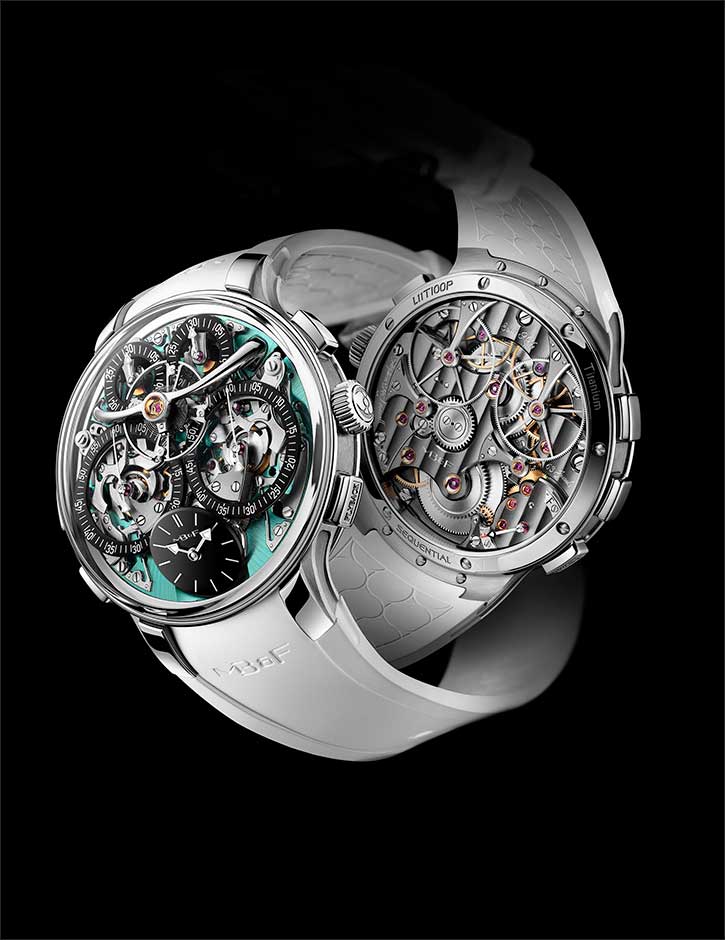
A new EVO edition in titanium with an aquamarine dial plate, now sporting flyback chronographs and a tilted dial for the time The quick facts
In 2022, MB&F unveiled its Legacy Machine Sequential EVO, a twin chronograph that opened up a world of timing possibilities. This ground-breaking chronograph redefined the chronograph as we knew it, winning the hearts of collectors and the coveted GPHG ‘Aiguille d’Or’ award the same year. Conceived by Stephen McDonnell, one of the original MB&F Friends and the mastermind behind the 2015 LM Perpetual, the LM Sequential EVO was one of those timepieces that was so profoundly useful that it made you wonder why no one had thought of it before. Multiple timing modes allowed you to time everything from two athletes at the same time to consecutive lap times around a track, to name a few of its extremely practical applications. But if the LM Sequential EVO wasn’t mind-blowing enough, there was another feature that Stephen and MB&F were keen to include: the flyback function. Stephen’s original prototype movement was actually designed with a flyback system and provisions for it were built into the LM Sequential EVO. But it was extremely complicated to perfect with the watch taking nine months of prototyping, four of which were dedicated to the flyback function alone. Add to this, six different re-designs, and all the work and components that went with them, and McDonnell felt that it would be unwise - reckless even - to release the watch with a flyback when there were so many unproven elements in play. But the dream was there and everything was designed to be able to incorporate it at a later date; this was finally achieved in 2024, with the release of the LM Sequential Flyback, housed in the more classic Legacy Machine case. In 2026, the Flyback function finds its way into a new EVO edition: the LM Sequential Flyback EVO, in a grade 5 titanium case, with aquamarine dial plate. On the same occasion, it inherits another feature from the more classic LM Sequential edition: a tilted dial for the time, improving its legibility. The internal jewelling of the vertical clutches is the key to the whole Sequential chronograph, and the flyback system also requires jewelling, without which it would not work. The system is very subtle, and a great deal of work went into reducing all the friction to a minimum so that the flyback did not cause the return-to-zero to block. To achieve this, McDonnell incorporated a special jewelled roller into the flyback mechanism. Such a component is unavailable directly from any supplier of jewels, so for the first prototype, McDonnell made the jewel himself in order to prove the concept of this ground-breaking mechanism (one of five patented elements). EVO features The EVO treatment comprises a series of design and engineering upgrades applied to select Legacy Machine references, reshaping them into watches better suited for daily wear and a more dynamic lifestyle. Notable elements of the EVO lineup include 80-metre water resistance, a screw-down crown, an integrated rubber strap, and MB&F’s proprietary FlexRing shock-absorption system, positioned between the case and the movement to safeguard the mechanism during active use. To heighten durability and comfort, the models also incorporate advanced materials like zirconium and titanium. Aesthetically, the EVO pieces distinguish themselves with their ergonomic case architecture and seamlessly integrated strap, as well as the absence of a conventional bezel, which allows for an open, unobstructed view of the Super-LumiNova-boosted displays beneath their domed sapphire crystals. Within, the movements receive darkened finishes that underscore the collection’s modern, sporty character. So, what can it do? The LM Sequential Flyback EVO features the same layout as the LM Sequential EVO with two chronograph displays. One has its seconds display at 9 o’clock and minutes display at 11 o’clock. The other has its seconds display at 3 o’clock and minutes display at 1 o’clock. Each of these chronographs can be started, stopped, and reset completely independently of the other, using the start/stop and reset pushers on their respective sides of the case. With the flyback function, the reset pushers also trigger the flyback if the corresponding chronograph is running. These pushers make up the four chronograph pushers you would usually associate with having two chronograph mechanisms in one watch. However, there is a fifth pusher, called the Twinverter, located at the 9 o’clock position. This “magic button” as Stephen likes to call it, is the secret that elevates the functionality of the LM Sequential timepieces beyond any existing chronograph wristwatch. It controls both chronograph systems, operating as a binary switch that inverts the current start/stop status of each chronograph. This means that if both chronographs are stopped, pressing the Twinverter causes both of them to start simultaneously. If they are both running, the Twinverter makes them stop. And, if one is running and the other is stopped, the Twinverter stops the one that is running and starts the one that is stopped. In terms of practical applications, these functions allow the chronograph to be useful in numerous situations, as the following examples illustrate: 1. Independent mode Imagine the preparation of a meal, where different things need to be cooked for different periods of time, at different points in time. You would operate the two chronographs via their respective pushers - for instance, starting one when you put your pasta into boiling water and starting the other when the vegetables go in the oven. In fact, this application comes in handy in all areas of personal productivity. At the gym, for example, one chronograph can be set to time your entire session whilst the second is used to record your time at each station. In this example, the new flyback function can come in handy to swiftly reset and restart the timing sequence with a single press on the reset button, combining the three steps - stop, reset to zero, and re-start - in one. 2. Simultaneous or split-second mode This mode can be used in a race involving two competitors, starting simultaneously. The Twinverter allows the wearer to start both chronographs at exactly the same time, but the different end times can be easily recorded by pressing each chronograph’s individual start/stop pusher. To note, the durations of the events can exceed 60 seconds, which is the limit for the vast majority of split-second chronographs on the market. In this mode, you can also use the new flyback function if you want to quickly restart timing. 3. Cumulative mode In the work environment, you might want to know how much time you spend on two separate projects as you switch between them. By starting one chronograph when you begin working on one task, and then using the Twinverter when you shift focus to the second task (switching again when you go back to the first), you can easily track the amount of time you cumulatively spent on each task. Another example of this is the timing of a chess match. 4. Sequential mode (or lap-timer mode) This mode can be used to measure individual lap times. Starting one chronograph at the beginning of an event and using the Twinverter upon the completion of a lap instantly launches the second chronograph in order to time the next lap, while the first chronograph is stopped, allowing ample time for the timing result to be noted down. The stopped chronograph can then be reset to zero, ready to be relaunched with the Twinverter for the following lap. Thanks to its minutes’ totalisers, the LM Sequential can be used effectively in sporting events with average lap times of over a minute (which includes the vast majority of motor sports). 5. Flyback mode The flyback was originally developed in the 1930s for airplane pilots, to allow accurate timing of flight paths from waypoint to waypoint. It was found that the time to stop, reset, and restart a chronograph took so long that errors in navigation would result, which would be compounded as these accumulated over the course of a journey with multiple legs. The flyback allowed this to be done simultaneously: stop, reset and restart in a single press on the reset pusher. Combining the new flyback function with the other timing modes of the Sequential calibre offers even more functionality. For example, a pilot can keep track of overall flight time on one chronograph, while using the other chronograph to accurately time each leg with the flyback function. Powering such an engine The design of the Sequential calibre is completely unique. It encompasses two independent chronographs within a single movement, both of which are linked to a common escapement and oscillator. The energy losses associated with a conventional chronograph are well known, so imagine what can happen with two chronographs in a single movement? The losses would be doubled, resulting in unacceptably poor performance. All this functionality within a single watch required the invention of a fundamentally new type of chronograph system, one which would not be susceptible to any sort of energy losses. This is exactly what the Sequential calibre does, thanks to the use of its innovative internally-jewelled vertical clutches and their associated control system. The new flyback mechanisms also incorporate jewelled rollers. Thanks to these patented solutions, the Sequential calibre outperforms conventional chronographs in terms of energy efficiency and precision. For the history buffs The word chronograph has Greek etymological roots. The first part comes from χρόνος (chrónos), meaning time, as seen in words such as chronology and chronicle. The second part is derived from γρᾰ́φω (gráphō), meaning to write, to make a written record of something. Just as a phonograph describes a system of recorded sound and a photograph is recorded light, a chronograph gives us recorded time. In the early 19th century, chronographs were associated with horseracing, developed according to the necessity to precisely determine the timing results of such a fast-paced sport. These early chronographs used droplets of ink to mark timings on dials even as they continued to run, allowing specific timings to be preserved for the record (at least until the chronograph was stopped and the dial wiped clean for the next race). In the early days of motor racing, a timing system was used whereby multiple chronograph pocket watches were mounted on a frame, and a “combined operating lever” allowed all of the watches to be actuated simultaneously. However, there were inherent inaccuracies in this approach, as the multiple watches would often run at slightly different rates. Moreover, such a cumbersome arrangement could clearly never be worn on the wrist. When Maximilian Büsser spoke to Stephen McDonnell in 2016, raising the possibility of a follow-up to Legacy Machine Perpetual (2015), the response from Stephen was four words long: “I have an idea.” It was a response as cryptic as it was exciting, particularly if you knew the kind of ideas that came from the mind of Stephen McDonnell. That conversation with Max accelerated a train of thought that Stephen had been mulling over for some time - that most modern chronographs were unable to adequately perform the job they had been designed for. The combined operating lever immediately suggested itself to him as a way to ensure that sequential race events could be measured with maximum precision with a manually operated mechanical chronograph. The provision of two independent chronograph systems which could be actuated together simultaneously meant that different timings could be taken and preserved long enough for the results to be recorded. The key would be to find a way to pack all of this functionality into a single wristwatch… From then on, the various solutions fell into place. Using two separate chronograph mechanisms linked to the same oscillator - an idea practically made for the Legacy Machine, with its central flying balance wheel - meant that timing errors due to tiny chronometric discrepancies between different timers would be eliminated. Stephen McDonnell continued to refine his vision of the ideal chronograph, reconfiguring the chronograph vertical clutch to sit within the main gear train in order to eliminate the infamous flutter of the chronograph seconds hand without the need for an amplitude-draining friction spring. He incorporated internally jewelled chronograph clutch shafts that would make amplitude fluctuation between the active and inactive modes of the chronograph a thing of the past. The crowning touch to Stephen McDonnell’s ideal chronograph, augmenting the role played by the combined operating lever found in historical chronograph systems, is the Twinverter concept. The ability to toggle instantly between chronograph operating modes directly opens up this age-old complication to be used in a variety of situations in modern daily life. It is the programming logic gate of mechanical watchmaking, a system that could have been devised only by the creator of the mechanical processor at the heart of Legacy Machine Perpetual. Dream-maker meets watchmaker: more about Maximilian Büsser and Stephen McDonnell Those who know the story of MB&F will know that Northern Ireland watchmaker Stephen McDonnell is counted among the key figures who brought the first creations of Max Büsser into the world. He was one of the handful of watchmakers who assembled the first few movements for what would become Horological Machine N°1. A decade later, Stephen McDonnell re-entered the world of MB&F to develop the Legacy Machine Perpetual: a groundbreaking approach to one of the most prestigious traditional high complications, the perpetual calendar. His philosophy of watchmaking is directly complementary to that of Max, taking a blue-sky approach to practical horology, compared to Max’s way of turning space-age fantasies into wrist-worn realities. LM SEQUENTIAL FLYBACK EVO TECHNICAL SPECIFICATIONS Legacy Machine Sequential Flyback EVO is released in a titanium edition with an aquamarine dial plate Engine
Functions
Case
Strap & buckle Integrated rubber strap with titanium folding buckle. 'FRIENDS' RESPONSIBLE FOR LM SEQUENTIAL FLYBACK EVO
| |||
|
| |||
| |||
| |||
| |||
| ||||||||||||||||||||||||||||||||
| ||||||||||||||||||||||||||||||||
| ||||||||||||||||||||||||||||||||