
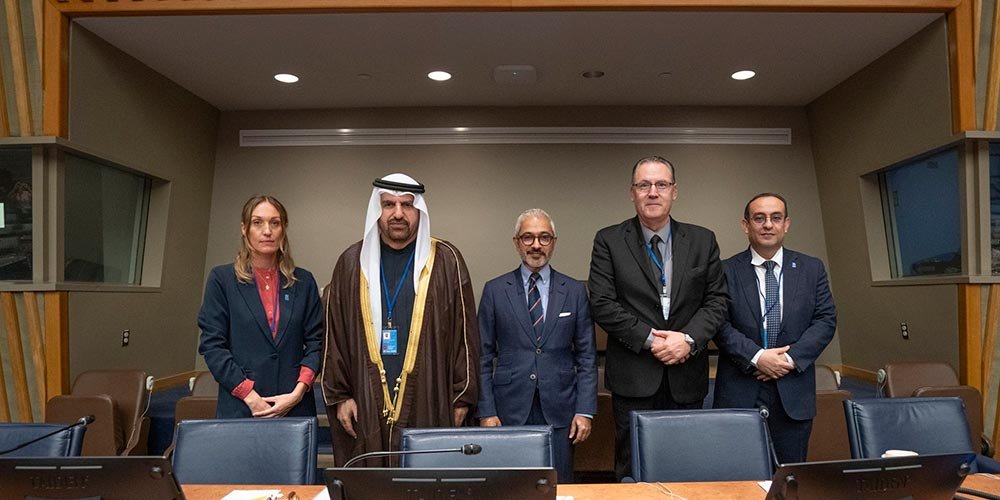
New York, 26 September 2026— Policymakers, leaders of knowledge institutions, private-sector executives and young people alongside senior UN officials, representatives of Member States, and mission delegates debated the central role of knowledge in crisis forecasting and mitigation at a high-level event, held today on the sidelines of the 81st session of the United Nations General Assembly (UNGA).
The Mohammed bin Rashid Al Maktoum Knowledge Foundation (MBRF) and the United Nations Development Programme (UNDP) Regional Bureau for Arab States, together with the Permanent Mission of the United Arab Emirates to the United Nations, convened the event at the United Nations Headquarters in New York, titled ‘Knowledge as a Crisis Compass: Anticipate, Adapt, Advance.’
“Our collaboration with UNDP embodies our dedication to transforming knowledge into practical tools that empower societies to anticipate emerging shifts, adapt to evolving challenges, and turn disruptions into opportunities,” said H.E. Jamal bin Huwaireb, CEO of MBRF. “Through initiatives such as the Global Knowledge Index and Future Skills Academy, our goal is to equip individuals and institutions with the capabilities required to build resilient, innovative, and future‑ready economies.”
Discussions considered practical instruments developed through the MBRF-UNDP partnership, including the Global Knowledge Index and Future Skills Academy. These tools illustrate how knowledge can be operationalized to assess strengths and gaps in a country’s knowledge ecosystem and equip individuals with the resources required to navigate rapidly changing labor markets, as well as economic, technological, and green transitions.
“Crises today rarely arrive alone; they cluster and cascade across systems, which means knowledge can no longer be applied only after the fact. It must help decision-makers anticipate risk and adapt in real time,” said Abdallah Al Dardari, UN Assistant Secretary-General and Director of UNDP’s Regional Bureau for Arab States. “Our long-standing partnership with MBRF reflects this shift, treating knowledge as core infrastructure for development and demonstrating how practical tools help nations move beyond crisis toward sustained progress.”
Discussions emphasized the future of economies, exploring how innovation, technology, artificial intelligence, and entrepreneurship can prepare institutions and businesses for economic, digital, and climate transitions. It also addressed challenges central to the Arab region, stressing the need to reinforce local and regional capacities to anticipate, absorb, and recover from the impacts of crises.
The ideas and insights shared in the event will shape the agenda of the next iteration of the Knowledge Summit – a flagship activity of the MBRF-UNDP Knowledge Project, which has convened annually in Dubai since 2014.