
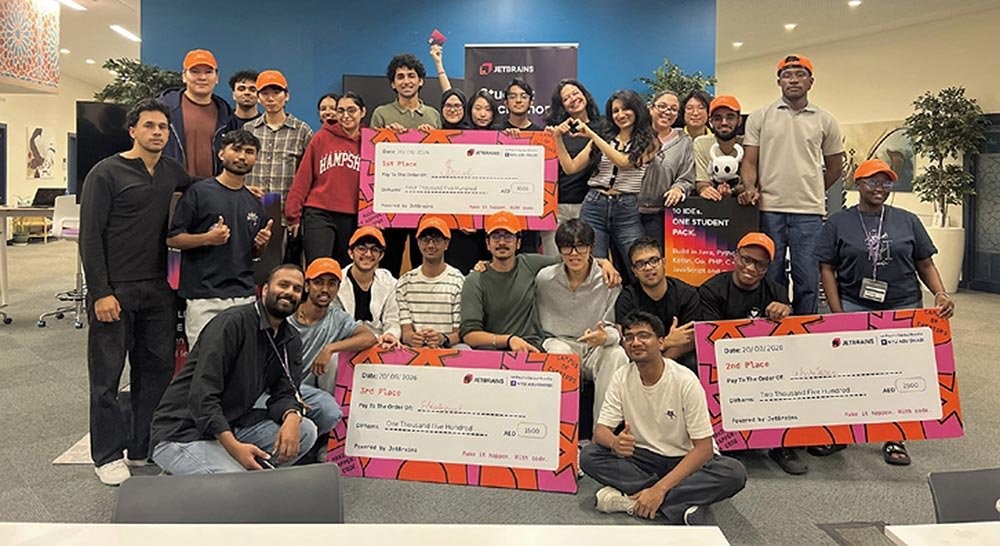
Students at NYU Abu Dhabi and 42 Abu Dhabi built and pitched working technology solutions with tools and support from JetBrains
Abu Dhabi, United Arab Emirates, 28 September 2026:
Aspiring developers from NYU Abu Dhabi and 42 Abu Dhabi put their coding, AI, problem-solving and software development skills to the test this week, building prototypes to address real-world challenges through two hackathons supported by global software company JetBrains.
The events were held on 20 September at NYU Abu Dhabi, which held a one-day hackathon at NYUAD Career Development Center, and on 22–23 September at 42 Abu Dhabi. Both institutions hosted hackathons on their campuses to enable NYU Abu Dhabi and 42 Abu Dhabi students to apply their skills in a hands-on development challenge.
At both hackathons, students were challenged to move from a problem statement to a working product under tight deadlines, before demonstrating their solutions, explaining their technical choices and showing how they had tested their work.
At the NYU Abu Dhabi event, first place went to $ocial, a personalized activity discovery and budgeting app that connects with a user's calendar and monthly budget to recommend relevant activities that fit both their available time and spending limit. Waste Track took second place and Elderly Assist third. The Best Use of JetBrains AI award recognized a tool designed to help companies understand the considerations involved in expanding into MENA, while the Judges' Choice Award was shared by two teams that developed Nepal-focused disaster-management platforms.
At 42 Abu Dhabi, Team Kartoshka won the "Build What Developers Need" challenge with Lattice, an AI agent integrated into the IDE that coordinates and monitors other coding agents while giving developers visibility into agent activity and potential conflicts in collaborative projects. Team Placebo placed second with a healthcare development and legacy-code assistant, while Hybrid Falcons took third with a developer wellness plugin designed to enforce scheduled activity breaks.
The events took place as the UAE continues to invest in digital innovation. Under the Abu Dhabi Government Digital Strategy 2025–2027, AED13 billion will be deployed to support digital transformation and technology adoption. The strategy is expected to contribute more than AED24 billion to Abu Dhabi's GDP and create more than 5,000 employment opportunities by 2027.
AI is also changing how developers approach their work. The JetBrains Developer Ecosystem Survey 2026 found that, between May and July 2026, 90% of professional developers used AI coding agents at work at least weekly, while 68% used them daily.
These tools can generate code and automate parts of the development process, helping developers move from an idea to a prototype faster. The harder task is turning that output into software that works, can be understood and remains reliable. Developers still need to evaluate outputs, test and troubleshoot software, make informed technical decisions and take responsibility for the result.
"AI can generate code in seconds. Responsibility for what that code does still sits with the developer," said Nadia Rinsky, Head of Business Development for the MENA region at JetBrains, who was one of the Hackathon judges. "The students had to go beyond producing code. They needed to understand what they were building, test their ideas, explain their decisions and demonstrate that their solutions worked. AI gives developers more leverage, which makes technical judgement, verification and accountability even more important."
From problem statement to working product at NYU Abu Dhabi
On 20 September, students took part in a one-day hackathon at NYU Abu Dhabi, organized by the NYUAD Career Development Center in collaboration with student-led clubs HackED and Violet Ventures and powered by JetBrains Academy.
The Kotlin Multiplatform Challenge asked teams to create an application that supported communities, raised awareness or addressed a real-world problem. Within a single day, they had to turn their idea into a working prototype that ran on at least two platforms. A JetBrains Academy workshop, hands-on experience with JetBrains tools and support from industry mentors helped teams prepare for their final pitches.
JetBrains Academy provided a total prize pool of AED10,000, distributed as Amazon gift cards. Members of the winning teams also received the JetBrains Professional All Products Pack, including professional JetBrains tools and an expanded AI quota.
The judging process placed particular emphasis on whether teams had built something that worked, with 35% of the score allocated to product functionality. The remaining criteria assessed the strength of the problem and insight, technical execution and clarity of the final pitch.
The format reflected the realities of software development: working under time pressure, making decisions with incomplete information, testing assumptions and communicating both the value and the limitations of the finished product.
Dana Downey, Associate Dean of Student Affairs & Director, Career Development Center, said: "Our students build on their strong technical knowledge from the classroom by putting it into practice at events like this hackathon. The hackathon allows for innovation under pressure, similar to what they will experience in the workplace. Preparing students for these realities, before they face them on the job, builds confidence and agility our graduates carry into their future beyond NYU Abu Dhabi."
Preparing students for a changing software industry
On 21 September, JetBrains also took part in an Employee Spotlight session at NYU Abu Dhabi, engaging primarily with students studying computer science, engineering, mathematics and electrical engineering.
At the JetBrains booth, students could learn more about career opportunities, test their technical knowledge through a quiz and speak directly with the team about careers and the skills increasingly required in software development. Later that day, a JetBrains Developer Advocate delivered a presentation, examining how AI is being used in industry and how AI agents work.
42 Abu Dhabi equips talent for the AI-driven future of software development
On 22 and 23 September, students at 42 Abu Dhabi took on the "Build What Developers Need" challenge, creating a plugin for an IntelliJ-based development environment that addressed a practical need in a developer's workflow.
Teams were asked to consider the context of an existing codebase, established development practices and how naturally their solution would fit into the way developers already work. The challenge tested more than coding ability: students also had to identify a genuine problem, design a usable solution and explain the decisions behind it.
The challenge reflected 42 Abu Dhabi's peer-to-peer, project-based learning model, where students develop their capabilities through hands-on challenges, collaboration and practical problem-solving. As AI continues to transform software development, the Academy is increasingly focused on equipping talent with the technical judgement, adaptability and problem-solving capabilities required to work effectively with AI and emerging technologies.
The tuition-free Academy welcomes applicants from diverse backgrounds, and its admissions process is designed to identify potential and motivation, rather than relying on previous coding experience.
Fatima Al Foulathi, Acting CEO, 42 Abu Dhabi, stated: "At 42 Abu Dhabi, we are preparing talent not only to adapt to an AI-driven future, but to help shape it. As AI transforms how technology is built, the ability to think critically, solve complex challenges and apply AI responsibly is becoming as important as coding itself. This hackathon gives our students the opportunity to put those capabilities into practice by building, testing and presenting solutions in a real-world environment. Through our peer-to-peer, project-based learning model, we are empowering the next generation of technology talent with the skills, confidence and adaptability to contribute meaningfully to Abu Dhabi's growing digital and AI ecosystem."
Across both hackathons, students were asked to do more than produce code. They had to turn an idea into a functioning product, understand the technology behind it and show that it worked. That combination of speed, judgement and accountability will become increasingly important as AI takes on more of the code-generation process.